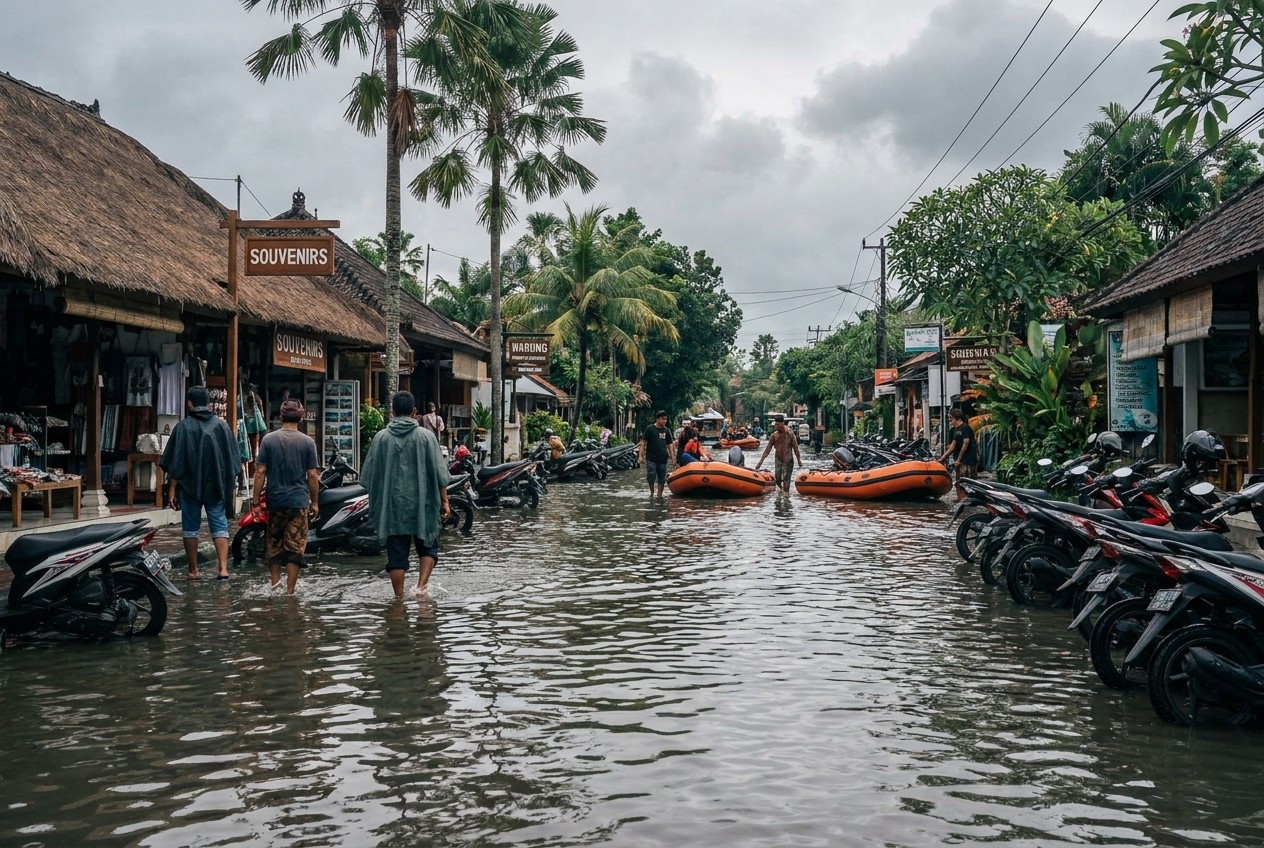
If you’ve been following the news this past month, you’ve probably seen the footage. Streets turned into rivers. Tourists being ferried out of Legian hotels on rubber boats. A giant snake — a real one — swimming through the streets of Kuta. Dramatic scenes from a place that most people associate with rice terraces, sunset cocktails, and barefoot luxury.
It’s understandable if that imagery gave you pause, especially if you’re in the middle of evaluating a property purchase in Bali, or thinking seriously about one.
So let’s talk about it honestly.
Not with spin, and not with blind reassurance. Just a clear-eyed look at what actually happened, what it means for the market, and how smart investors should be thinking about this. Because the answer is more nuanced than either the headlines or the cheerleaders suggest.
What Actually Happened in February 2026
Bali experienced several consecutive days of intense monsoon rainfall in late February, the kind that pushes already-swollen river systems past their limits.
Indonesia’s meteorological agency, BMKG, issued red-level weather alerts. The highest classification available across six regencies: Denpasar, Badung, Gianyar, Tabanan, Klungkung, and Karangasem. In parts of Kuta, Legian, and Denpasar, floodwaters reached up to one metre in residential streets. Emergency teams deployed rubber boats to evacuate residents and tourists. In Ubud, landslides damaged religious sites and temporarily blocked road access near The Yoga Barn.
Around 350 people were temporarily displaced. Two international flights were diverted. BMKG also warned of wave heights up to four metres in the southern Indian Ocean, a serious hazard for ferries and small vessels operating around the island.
The good news: no fatalities were reported from the flooding itself. Ngurah Rai International Airport stayed open and operational throughout, with only minor disruptions.
It was serious. It was disruptive. And within days, the waters had receded and life had returned to normal across most of the island.
Is This Unusual? Not Really And That's Important Context
Here’s something that rarely makes it into the international coverage: Bali floods every wet season. Not everywhere, and not always this severely, but the pattern itself is not new.
Bali’s wet season runs from roughly October through March, with January and February typically seeing the heaviest rainfall. Low-lying areas in South Bali — particularly around Kuta, Legian, and parts of Denpasar — deal with some degree of seasonal flooding most years. Local residents know this. Businesses plan around it. It’s part of living on a tropical island that sits squarely in the path of the Asian monsoon.
What made February 2026 notable was the sustained intensity, several consecutive days of rain pushing saturated river systems beyond capacity, rather than a single heavy downpour. The result was more severe than a typical wet season event.
But the underlying dynamic? That’s not a surprise. And for investors, understanding that distinction matters enormously.
Seasonal weather is a known variable. It can be assessed, planned for, and mitigated through smart location choices. It is not, and this is worth stating clearly. A reason to write off Bali as an investment destination.
Which Areas of Bali Flood the Most?
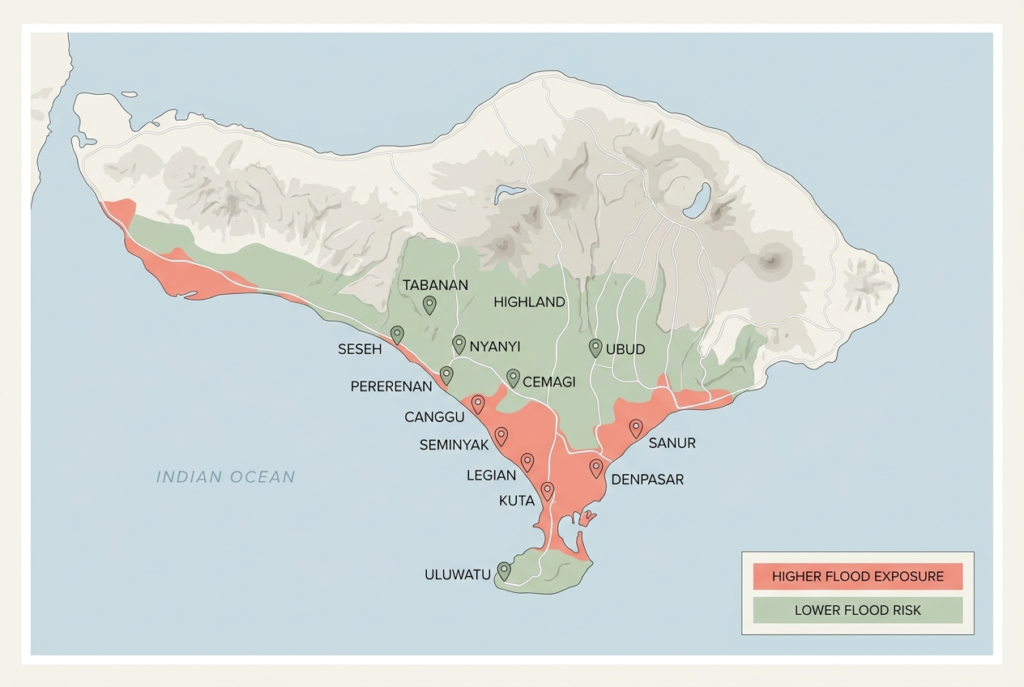
This is the question that actually matters for investors, and it’s one that deserves a straight answer rather than vague reassurance.
Bali’s flood risk is almost entirely tied to elevation and proximity to river systems. The island’s low-lying coastal plains, particularly in the south, are where flooding concentrates. Get above them, and the picture changes dramatically.
Areas with higher flood exposure:
- Kuta and Legian: flat, low-elevation, high-density corridors that have flooded repeatedly over the years
- Parts of Denpasar: the urban capital, where river overflow affects residential and commercial streets regularly
- Sanur (low-lying sections): coastal exposure with drainage challenges during sustained heavy rain
- Select parts of Canggu: rapid development in recent years has outpaced drainage infrastructure in certain pockets
Areas that have historically shown greater resilience:
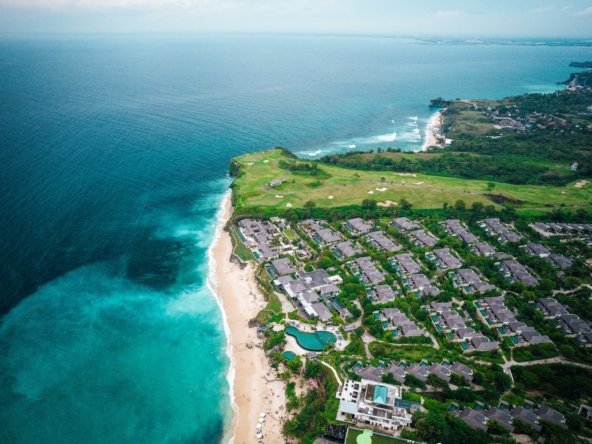
- Uluwatu and the Bukit Peninsula: built on a limestone plateau, with natural drainage and minimal flood history
- Pererenan and Cemagi: elevated above the low ground that floods further south
- Nyanyi and Seseh: emerging corridors with favourable topography for investors
- Tabanan highlands: less developed, naturally elevated, and increasingly on investors’ radar
- Most of Ubud’s established villa zones: while landslide risk exists on steep hillsides, the majority of developed villa land sits on stable, elevated ground
This isn’t a definitive risk map, every individual site needs its own assessment. But as a starting framework, elevation and distance from waterways are your two most reliable guides.
What This Means If You're Currently Looking to Buy Property in Bali
Here’s the honest version: the February 2026 flooding should not stop you from buying in Bali. But it should sharpen the questions you ask before you do.
Buying property in Bali safely comes down to asking the right things and knowing what to look for in the answers.
Ask About the Specific Site, Not Just the Area
“I’m looking in Canggu” is not a risk assessment. Canggu is a wide area with significant elevation variation and very different flood profiles depending on exactly where the property sits. Push for elevation data, proximity to rivers or drainage channels, and where available historical flood records for that specific plot. A credible agent or developer should be able to provide this without hesitation.
Look at How the Property Is Built
Quality construction in Bali accounts for the wet season. Raised foundations, properly designed drainage channels, high-grade waterproofing and roofing, these are not luxury features, they’re baseline requirements for a property that will perform consistently. When you’re reviewing a development, ask specifically about wet-season design standards. The answer will tell you a lot about the developer.
Don’t Skip Insurance
Property insurance in Indonesia that covers natural disasters is available and, frankly, non-negotiable for serious investors. Many premium developments, particularly those built for the short-term rental market, carry developer-level insurance, but scope and coverage vary. Confirm this independently rather than assuming it’s in place.
Work with Someone Who Actually Knows the Ground

Flood risk Bali villa investment decisions cannot be made from a laptop screen thousands of kilometres away. The difference between a flood-resilient site and a flood-exposed one can be a matter of two or three metres of elevation and a hundred metres of distance from a river, details that don’t appear in listing brochures. A buyer’s agent with genuine local knowledge is one of the most practical investments you can make at the due diligence stage.
Does Flood Risk Actually Affect Property Value?
More than most people realise and this is where it gets interesting for investors who are paying attention.
Properties in elevated, demonstrably low-risk locations have consistently held stronger value trajectories than their flood-exposed counterparts. This isn’t just about avoiding downside risk. It’s about understanding that discerning renters and buyers increasingly factor location quality, including flood resilience, into their decisions.
A well-positioned villa on elevated ground in a premium corridor like Uluwatu or Pererenan commands stronger rental rates, maintains higher occupancy through the wet season, and tends to attract a more stable, higher-quality tenant profile. Over a five-year hold, the performance gap between a thoughtfully located property and a poorly located one in the same general area can be surprisingly wide.
On the flip side, flood-exposed properties sometimes present at lower entry prices. Which can look attractive on a spreadsheet. But factor in potential wet-season rental disruption, elevated maintenance costs, and longer-term resale considerations, and that apparent saving often disappears.
The investors who navigate this market well are the ones who look past the headline price and think about the full picture.
The Bigger Picture: Bali's Investment Case Hasn't Changed
Floods make headlines. They also recede. And what doesn’t recede is the underlying strength of Bali as a market.
Consider what remains true regardless of the February weather events:
Bali welcomed over 6.3 million international visitors in 2024, with tourism numbers continuing their upward trajectory. The island’s short-term rental market, driven by a global base of digital nomads, remote workers, lifestyle travellers, and high-spending tourists remains one of the most resilient in Southeast Asia. Premium land in sought-after corridors remains genuinely scarce. Infrastructure continues to improve. And for foreign investors, accessibility through PT PMA structures and long-term leasehold arrangements remains a workable, well-established pathway.
None of that has changed because it rained heavily for a week in February.
What good investors do with moments like this is use them as a filter, a prompt to ask sharper questions about location, construction quality, and risk management. The ones who do that work tend to end up with better assets than those who either panicked and walked away or ignored the risks entirely.
Our Honest Take
We work in this market every day. We live here. And when we saw the footage circulating in late February, our first instinct wasn’t to minimise it or spin it. It was to reach out to clients who we knew would be watching and ask: do you have questions? Let’s talk through them.
Because that’s what this moment calls for. Not a sales pitch. Not blind reassurance. Just honest, informed conversation about what the risks are, where they apply, and how to make a smart decision in spite of or sometimes because of the noise.
If you’re currently evaluating a Bali property investment and the recent flooding has raised questions for you, we’d welcome that conversation.
FAQ SECTION
Q: Which areas of Bali flood the most during the wet season? The highest-risk areas are generally Kuta, Legian, low-lying parts of Denpasar, and select zones within Canggu. All flat, coastal, and close to river systems. Elevated areas like Uluwatu, the Bukit Peninsula, Pererenan, and most established villa zones around Ubud carry significantly lower flood risk and have historically been more resilient.
Q: Is Bali safe for property investment in 2026 despite the flooding? Yes, with the right location and due diligence in place. Seasonal flooding is concentrated in specific low-lying zones, not distributed evenly across the island. Investors who prioritise elevation, construction quality, and local expertise are largely insulated from flood-related disruption. Bali’s core investment drivers, tourism demand, rental yields, and land scarcity in premium areas, remain firmly intact.
Q: Does flood risk in Bali affect rental income from villas? It can, for properties in flood-affected areas. Severe weather events can lead to guest cancellations and access disruptions during what is otherwise peak booking season. Properties in elevated, flood-resilient locations are far less exposed to this and typically maintain stronger, more consistent occupancy through the wet season months.
Q: What due diligence should I do around flood risk before buying a villa in Bali? Start with the specific site, not just the general area. Request elevation data, proximity to waterways, and any available historical flood information for that plot. Review construction specifications for wet-season design standards. Confirm insurance coverage independently. And work with a buyer’s agent who has verified on-the-ground knowledge of local flood exposure, not just area familiarity.
Q: How long does Bali’s wet season last, and when is flooding most likely? The wet season typically runs from October through March, with January and February seeing the heaviest and most sustained rainfall. Flooding events are most common in this window, particularly after consecutive days of rain. From April onwards, the dry season brings significantly reduced risk across most of the island, and consistently Bali’s most reliably beautiful weather.